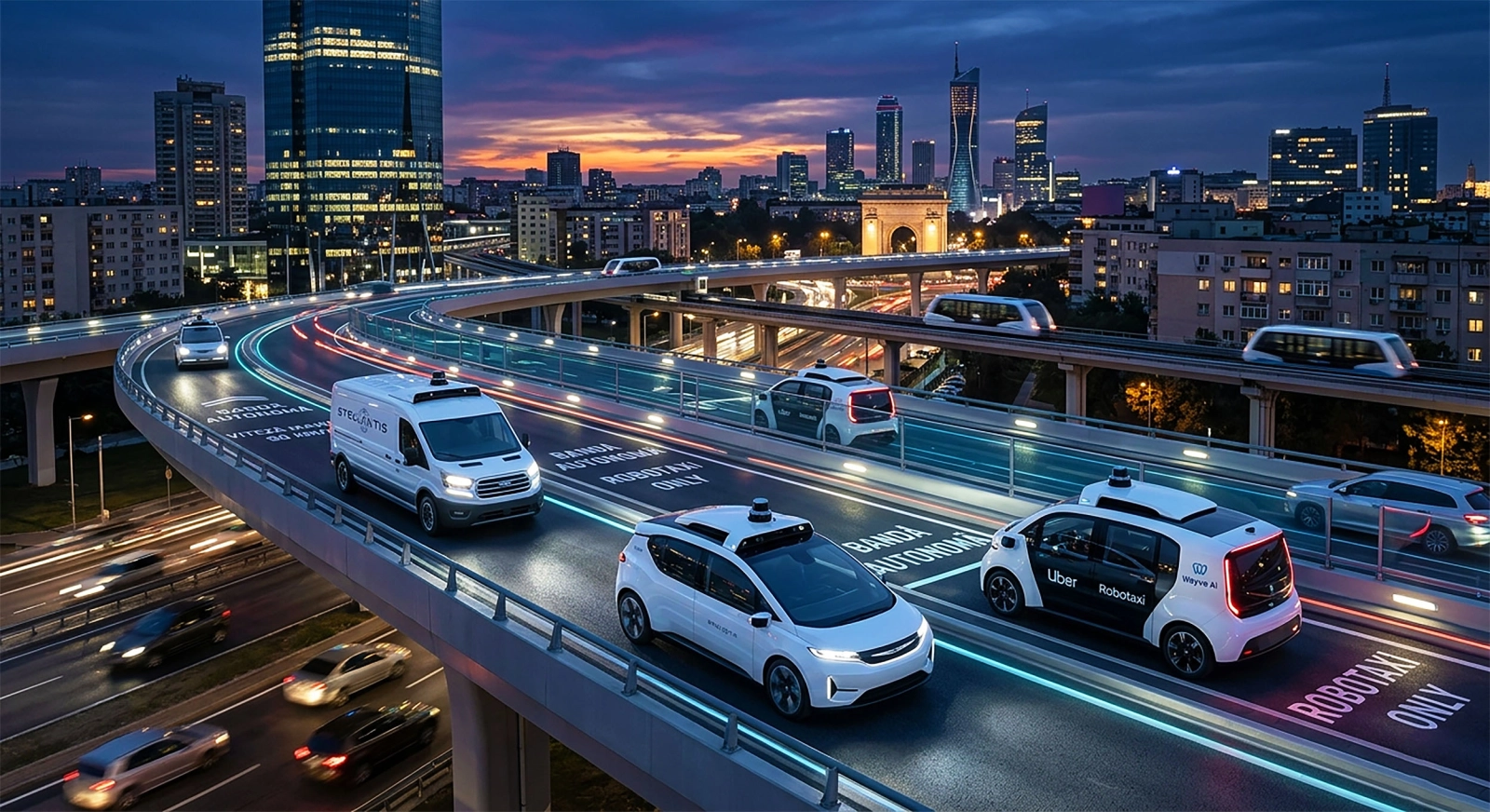
MOBILITY REVOLUTION: Stellantis, Wayve and Uber join forces to launch autonomous taxis in Europe and North America. What impact will the project have in Romania?
In a strategic move that promises to redefine the future of urban transportation, automotive giant Stellantis has announced a historic partnership with artificial intelligence leader Wayve and global ride-sharing platform Uber. The three companies will combine their technologies and resources to develop and deploy a fleet of fully autonomous Level 4 taxis (robotaxis) for major metropolises in Europe and North America.
The collaboration marks a turning point in the autonomous vehicle industry, combining Stellantis' large-scale manufacturing expertise, Wayve's AI innovation, and Uber's massive market infrastructure.
Three giants, one goal: Level 4 autonomy
According to the official press release issued by the partners, future robotaxis will not be simple adapted cars, but will be based on dedicated platforms, designed from scratch by Stellantis specifically to integrate Level 4 autonomous driving systems. This level of autonomy implies that the vehicle can manage all aspects of driving on its own in certain areas and conditions, without the need for the intervention or attention of a human driver.
While Stellantis will provide the “hardware” and vehicle platforms, Wayve will provide the “brains” of these vehicles. Wayve is known for developing software systems based on adaptive artificial intelligence. Unlike traditional technologies that rely on pre-rendered HD maps and rigid rules, Wayve’s AI enables autonomous taxis to understand, learn and navigate complex and unpredictable urban environments, automatically adapting to different regions and road conditions.
The final piece of the puzzle is Uber. The company will integrate these robo-taxis fleets directly into its global network, making it easier for millions of users to access the new technology through the app they already use every day.
“This collaboration brings us closer to delivering smarter, safer, and more efficient mobility for our customers,” said Ned Curic, Stellantis’ chief engineering and technology officer. “By combining our Level 4-ready platform […] with Wayve’s adaptive AI and Uber’s global network, we are accelerating the launch of autonomous vehicles that meet real customer needs and enable mobility at scale in everyday life,” he added.
Impact in Romania: Between technological leap and reality on the ground
Although the first phases of the project will target the metropolises of North America and Western Europe, the shock waves of this alliance will inevitably reach Romania. Uber has a substantial market share in the major Romanian cities (Bucharest, Cluj-Napoca, Timisoara, Iasi or Brasov), which means that the commercial infrastructure for the adoption of robo-taxis already exists. However, their local implementation will have to pass through several major filters:
1. Legislative vacuum and bureaucracy
Currently, Romanian road legislation (the Road Code) does not include clear regulations for the commercial operation of Level 4 driverless vehicles. For Romanians to be able to order an autonomous Uber, the authorities in Bucharest will need to adopt and implement European directives on autonomous transport. Romania has often been slow to regulate disruptive technologies, which could delay the arrival of robo-taxis by several years compared to the West.
2. The ultimate test for AI: The streets of Romania
Wayve's adaptive technology promises to work anywhere, but traffic in Romania's big cities presents a unique challenge. Faded or missing road markings, unpredictable potholes, poorly signalized infrastructure works, and the often aggressive or chaotic behavior of road users (including pedestrians and scooters) will put the car's sensors and algorithms to the test. In programmer jargon, if an autonomous driving algorithm can successfully navigate the Pia?a Roman? roundabout in Bucharest during rush hour, it can work anywhere in the world.
3. Economic impact on ride-sharing drivers
Uber has thousands of driver partners in Romania, many of whom practice this activity as their main source of income. The announcement of a long-term autonomous fleet will naturally generate concerns about job losses. However, industry experts estimate that the transition will be a hybrid and extremely slow one. Autonomous fleets will not replace human drivers overnight, but will coexist with them, initially taking over only the simplest and safest routes or covering periods of huge demand for transport.
Conclusion
The partnership between Stellantis, Wayve and Uber draws a clear line towards the future of global urban transport. Even if it will be some time before we see driverless Uber cars on the streets of Romania, this collaboration indirectly forces Romanian local authorities and urban planners to start thinking long-term: digitizing infrastructure, clarifying legislation and preparing cities for an era in which artificial intelligence will be at the wheel.