The G-Class legend is downsizing and moving to Hungary: Strategic details about the new "Baby G" and the one-billion-euro investment from Kecskemét
German automaker Mercedes-Benz is preparing a major move on the European automotive chessboard. Scheduled for launch in 2027, the brand's future compact off-roader — known among enthusiasts as the "Baby G" or "Little G" — will not be assembled in Graz, Austria (where the classic model is produced), nor in Germany, but in our neighbors, in Hungary, at the Kecskemét plant. The decision represents a major reconfiguration of the Stuttgart-based group's industrial footprint, aimed at optimizing production costs in an extremely competitive economic climate.
Kecskemét becomes the epicenter of Mercedes-Benz production in Europe
To prepare the assembly lines for the new little brother of the G-Class, as well as other latest-generation models, Mercedes-Benz has directed a massive investment of one billion euros to the Hungarian plant. This capital infusion will transform the Kecskemét plant into the brand's largest vehicle production facility in the European Union.
The economic impact at the regional level is considerable:
- Annual production capacity will be expanded to reach a volume of between 300,000 and 400,000 cars.
- The Hungarian plant will generate approximately 30% of the German manufacturer's total European production, a spectacular increase from the previous share of 15%.
- The workforce will be massively supplemented by adding about 3,000 new positions, bringing the total number of employees to 7,500 people.
This strategic relocation of production to Eastern Europe comes as Mercedes-Benz aims to reduce operating costs by around 10% by 2027 to counter global tariff pressures and fierce competition in the electric vehicle segment. The decision has already sparked strong reactions and protests from unions in Germany (such as IG Metall), who fear a decrease in volumes at historic plants such as Rastatt, Bremen or Sindelfingen.
Strategy change: "Little G" gets hybrid engines due to electric market
Although the “Baby G” project was initially conceived exclusively as an electric vehicle (EV), the global slowdown in demand for battery-powered cars has forced the Stuttgart management to recalculate its steps. Thus, the new off-road model will be offered in the commercial network in both a 100% electric version and in hybrid internal combustion variants.
From a technical point of view, although the first reports indicated the use of the modular MMA (Mercedes Modular Architecture) platform, the German engineers opted for a unique architecture, capable of preserving the pure spirit of an off-roader. The electric version will benefit from a propulsion system consisting of two motors (eATS 2.0), standard all-wheel drive and an NMC battery of approximately 85 kWh, promising a theoretical maximum autonomy of up to 724 km (450 miles). For customers who prefer thermal propulsion, the hybrid variant will most likely borrow the powertrain from the new CLA: a 1.5-liter turbocharged gasoline engine, developed in partnership with Horse Powertrain, capable of offering high efficiency and zero-emission urban driving capabilities.
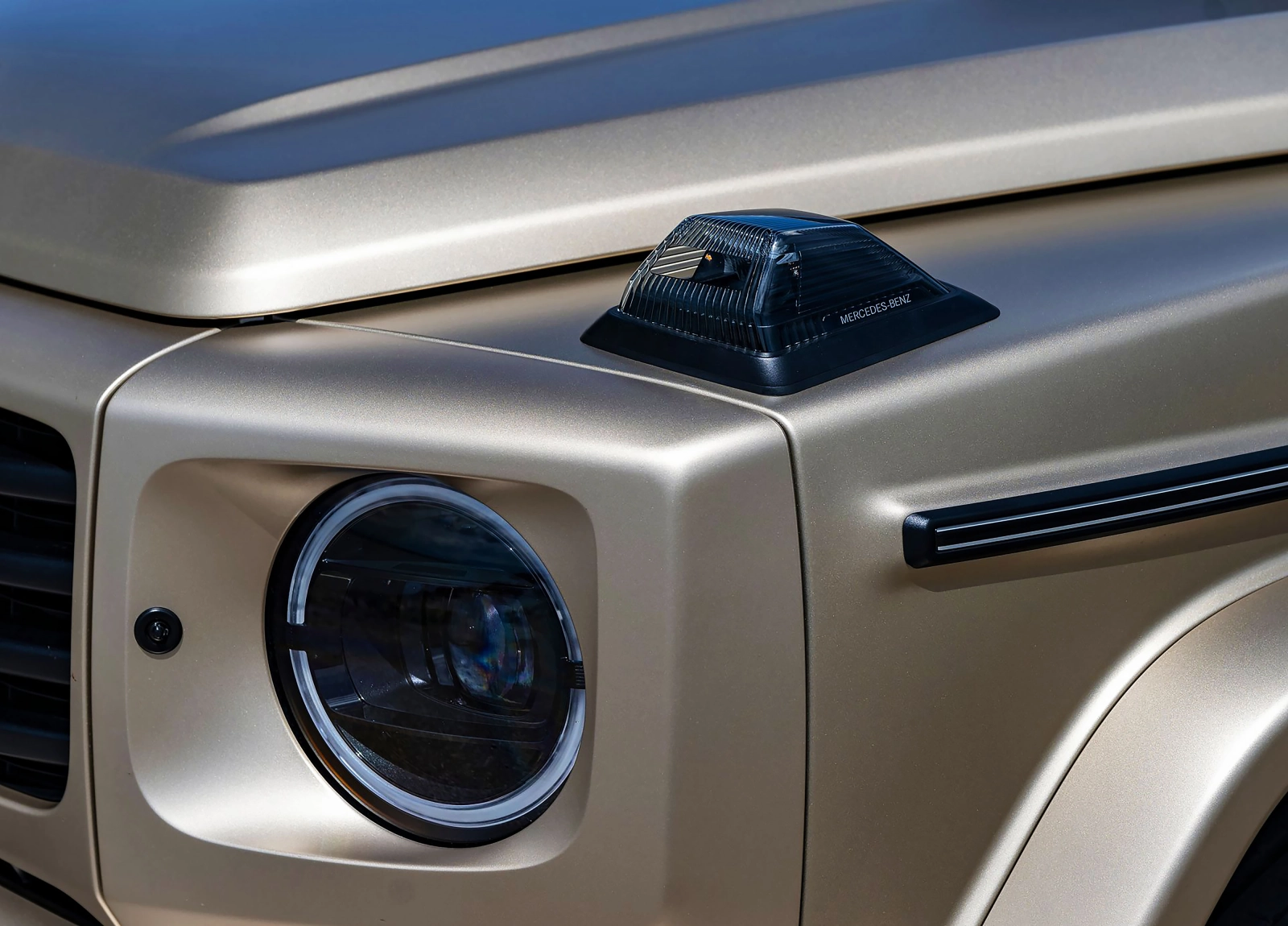
The design will remain faithful to the established cubic silhouette, retaining the iconic elements: the round headlights, the prominent fender-mounted indicators and the spare wheel fixed to the rear door, all configured in a 5-seat body and an estimated length of approximately 4.4 meters.
A diversified portfolio on the lines in Hungary
The new compact off-roader will share the Kecskemét production lines with a number of key models for the German manufacturer. Currently, the A-Class (whose life cycle has been extended until 2028 due to stable demand) and the EQB electric SUV (the electric variant of the GLB) are assembled there. In the coming period, the Hungarian plant will also take over the assembly of the new generation C-Class with electric technology, alongside the new CLA range, consolidating its status as a major technological hub located on the Romanian border.
How much will the new Mercedes Baby G-Class SUV cost in Romania?
Estimating the price for the future "Baby G" on the Romanian market requires a clear analysis of how Mercedes-Benz currently positions its SUV range and the major difference between a utility/family model (such as the GLB) and an image model, a lifestyle icon (such as the Little G will be).
Although the car's exterior dimensions (approx. 4.4 meters) will fall into the compact segment, the status of the "G" name and the dedicated off-road technology (ladder frame chassis and advanced axles) will attract a considerably higher price tag than that of a typical compact SUV.
Price estimates for the Romanian market (with 19% VAT included), compared to current forecasts by European analysts, look like this:
1. Entry version: Hybrid (MHEV/PHEV)
- Estimated starting price: €65,000 – €72,000
- Context: This variant will use the 1.5-liter turbocharged electric motor. The price strategically places it above a standard GLB (which starts in Romania at around €48,000), but very close to or slightly above a current-generation GLC (which starts at around €62,000). Customers will pay extra for the legendary design and native off-road capabilities.
2. Top version: Electric (EV)
- Estimated starting price: €78,000 – €85,000
- Context: The electric variant will incorporate expensive technology: 800-volt architecture for ultra-fast charging, two electric motors for true all-wheel drive and a generous battery of approximately 85 kWh. For comparison, the current EQB model starts in Romania at around €58,000, but the “Baby G-Class EV” will be a much more refined product from a technical and dynamic point of view, competing directly with the upcoming Land Rover Defender Sport EV and Rivian R2.
Where does it stand in relation to the "Big G"?
A classic Mercedes-Benz G-Class (G 450 d or G 500) starts in Romania at over €140,000, while the electric G 580 variant exceeds the €160,000 threshold.
Therefore, the new "Baby G" will be positioned exactly half the price of its bigger brother. The marketing strategy is obvious: democratizing access to the "G-Class" brand for a younger audience, who want the image and capabilities of a pure-blooded off-road vehicle, but at a cost and dimensions more adapted to the urban environment and weekend getaways.