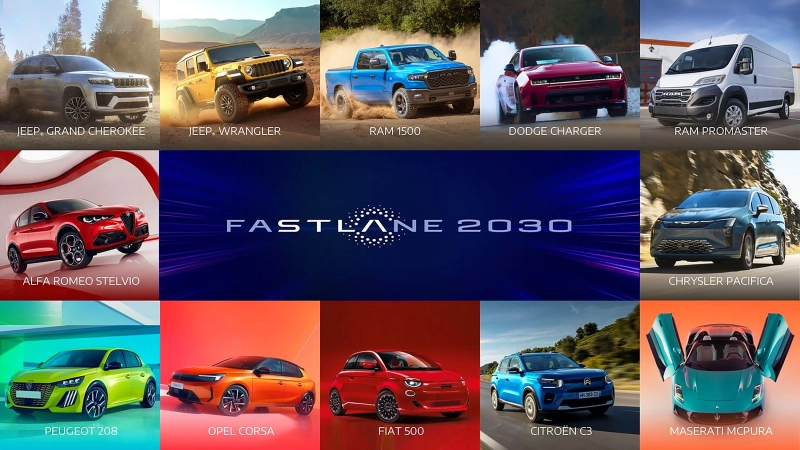
Stellantis announces FaSTLAne 2030 plan: 110 new cars and a new global architecture, STLA One
The multinational group is radically reorganizing its brand portfolio and launching the unique STLA One architecture, all with the aim of increasing its global revenues to 190 billion euros. The good news for fans? No brand is disappearing.
In an auto industry undergoing a major recalibration, Stellantis Group has decided that the best defense is a massive offense. During a strategy conference held at its North American headquarters, the auto giant officially unveiled its new master plan, titled FaSTLAne 2030.
This is the most ambitious and aggressive offensive in the group's history. Over the next five years, Stellantis aims not only to flood the market with an impressive number of new vehicles, but also to fundamentally reorganize its internal structure to maximize profit.
"FaSTLAne 2030 is not just a survival plan, but a roadmap for global dominance in an era of extreme efficiency."
The numbers behind the mega-investment
To get this industrial mammoth moving, Stellantis will put an astronomical investment of 60 billion euros on the table. The financial objectives are clear and extremely ambitious: the group expects a positive industrial flow of 3 billion euros by 2028, which will double to 6 billion euros by 2030.
The money will be strategically divided to achieve maximum impact:
- 36 billion euros will go directly to brands, with a special mention: 60% of this amount is reserved for the North American market, considered the main profit driver.
- 24 billion euros will be directed towards research and development, more specifically into state-of-the-art platforms and technologies.
By 2030, Stellantis is targeting a 23% increase in global revenues, targeting €190 billion (up from €154 billion reported in 2025). The growth will be felt differently by region: a 15% increase in Europe and a massive 25% jump in the North American market.
Product tsunami: 110 new cars by 2030
The centerpiece of the plan is a radical refresh of the product range. Stellantis will launch no less than 110 new machines worldwide.
Product strategy is divided almost equally between pure innovation and optimization:
- 60 completely new models, designed from scratch.
- 50 updated models (facelifts and major upgrades to existing vehicles).
The new brand map: Who goes global and who goes regional?
For fans worried about recent rumors about the possible elimination of historical brands, Stellantis has some excellent news: no brands will be abandoned. Instead, we are witnessing a profound administrative and commercial reorganization.
The brands were divided into three clear categories:
| Global Brands | Regional Brands | Specialty Brands |
| Fiat, Peugeot, Jeep, Ram | Citroen, Opel, Alfa Romeo, Dodge, Chrysler | DS Automobiles, Lancia |
The biggest news comes from the premium/specialty area. The DS and Lancia brands lose their total management independence and will be directly controlled by two large regional brands, in order to reduce administrative costs:
- DS Automobiles comes completely under the umbrella and control of Citroen.
- Lancia officially returns to where its historical heart is, being taken over by Fiat.
STLA One: The Platform That Promises to Reduce Industrial Chaos
On the technological side, Stellantis is betting everything on the new STLA One architecture, scheduled to debut in 2027. This represents a true masterpiece of financial and industrial engineering, with the mission of uniting 5 different platforms into a single modular architecture.
Through this movement, the group aims to:
- A 20% improvement in cost efficiency over the current level.
- Concentrating half of the world's production on just 3 common platforms.
- Standardization of components so that 70% of parts are reusable from one model to another.
Efficiency, but at what price?
The FaSTLAne 2030 plan also brings painful optimization measures for production capacity in Europe. Stellantis will reduce assembly capacity on the European continent by 800,000 units. However, the group's management wanted to provide an extremely important social insurance: no factory will be closed, the reduction will be made by streamlining shifts and optimizing workflows.
Call it what you will – restructuring, simplification or corporate pragmatism – but Stellantis has just demonstrated that it has a concrete plan to navigate the turbulent waters of the automotive transition. It remains to be seen whether the market will adopt the new pace imposed by FaSTLAne.