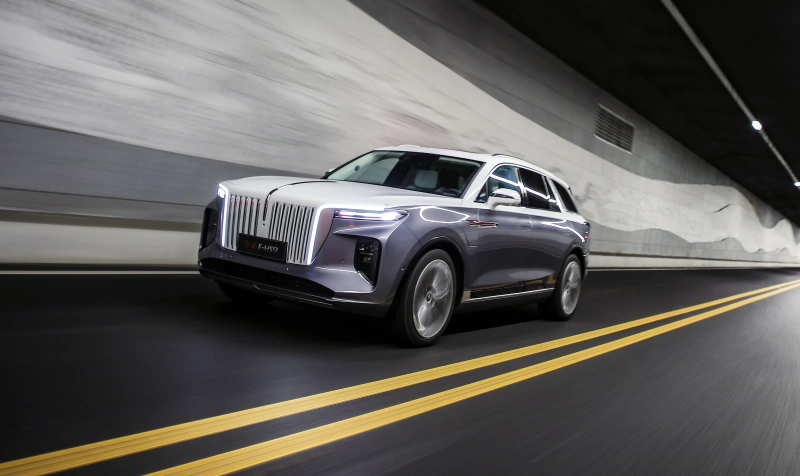
Red Flag on the Spanish Coast: Hongqi and Stellantis, a Strategic Alliance for the Conquest of Europe
The European automotive industry is undergoing an unprecedented reconfiguration, and Spain could become the "bridgehead" for one of the most exclusive brands in China. According to the latest market information, the conglomerate Stellantis is in advanced discussions with Hongqi to start producing electric vehicles in one of the group's plants in the Iberian Peninsula.
If the negotiations materialize, this would not just be a simple logistical move, but a diplomatic and economic victory in a climate marked by trade tensions between Brussels and Beijing.
A bridge called Leapmotor
The question on the lips of many analysts is: How did the giant that owns Peugeot and Fiat end up at the same table with the official limousine manufacturer from Beijing? The answer lies in a strategic partnership of the "Matryoshka doll" type.
The connection point is Leapmotor, another Chinese manufacturer in which Stellantis has invested heavily, holding a 20% stake. On the other hand, FAW Group (Hongqi's parent company) holds 5% of Leapmotor. This pre-existing connection facilitates dialogue and provides the legal and technological structure necessary for Hongqi to use Stellantis' assembly lines in Spain.
Who is Hongqi: China's "Rolls-Royce"
To Europeans, the name Hongqi (which translates to "Red Flag") may seem new, but in China, the brand is a living legend.
- Founded in 1958: It is the oldest and most prestigious car brand in China.
- The Power Car: For decades, Hongqi exclusively produced limousines for high-ranking officials of the Chinese Communist Party, including Mao Zedong.
- Top-notch design: The brand's current design director is Giles Taylor, former head of design at Rolls-Royce, which explains the imposing allure and exuberant luxury of recent models, such as the E-HS9 SUV.
- Global Ambitions: The brand left behind political exclusivity and transformed into a serious competitor in the premium and luxury segment, directly attacking the German triad (Mercedes-Benz, BMW, Audi).
Tariff Chess: Why Spain?
The decision to produce locally is not just a matter of pride, but one of financial survival. The European Union recently imposed significant countervailing tariffs on electric vehicles imported from China.
By assembling cars at Stellantis plants in Spain, Hongqi ticks off three objectives in one go:
- Avoiding customs duties: Cars produced in the EU are exempt from import tariffs.
- Speed of expansion: Hongqi wants to launch 12 new models (EV and hybrid) in Europe by 2028. Without a local production base, this pace would be impossible to sustain.
- Low costs: Using an existing infrastructure (such as the Vigo or Madrid plant) is infinitely cheaper than building a factory from scratch ("greenfield").
Stellantis, the "host" of Chinese brands
Hongqi is not the only name on Carlos Tavares' (CEO of Stellantis) guest list. The European giant seems to have adopted a strategy of "if you can't beat them, invite them to yours". The list of potential partners for production or distribution in Europe also includes:
- Dongfeng
- Xpeng
- Xiaomi (the brand that shook up the market with the SU7 model)
Figures of Hongqi's expansion in Europe
| Objective | Target Deadline |
| New model launches | 15 (EV & PHEV) |
| Dealership network | 200+ outlets |
| Market presence | 25 European countries |
| Strategic goal | Full localization by 2028 |
Although the discussions have not been officially confirmed by Stellantis representatives, the economic context and the links through Leapmotor make this partnership one of the most likely scenarios for 2024-2025. If the "Red Flag" waves over the Spanish factories, the automotive map of Europe will change forever.