Stellantis 2.0: The "Four Pillars" Strategy That Will Decide the Future of the Automotive Empire
In an automotive industry at a crossroads, where the transition to electric vehicles is clashing with the harsh reality of market demand, Stellantis — the colossus born from the merger of PSA and FCA — has decided to turn the page. After a 2025 marked by record financial losses and massive restructuring, the group now led by Antonio Filosa is preparing an industrial “reset” that will redefine the hierarchy of the 14 brands in its portfolio.
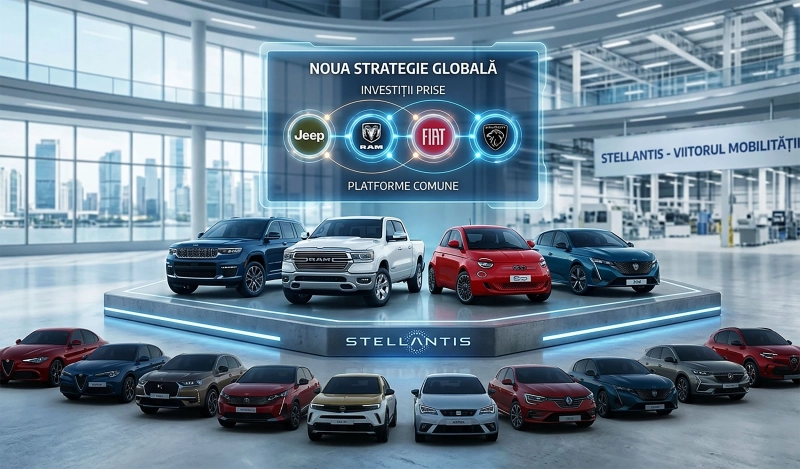
The new strategy, to be officially detailed on May 21, 2026, marks the end of the era in which all brands received equal attention. Stellantis is betting everything on the "Fantastic Four": Jeep, Fiat, Peugeot and Ram.
1. The Four Pillars: Who gets the "lion's share"?
Filosa's strategy is pragmatic: money goes where there is profit and global identity. Stellantis will focus the bulk of its investments in four brands that will serve as technology and platform donors for the rest of the group:
| Brand | Strategic Role | Primary Market |
| Jeep | Global leader in the SUV and off-road segment | Global / North America |
| Ram | Profit engine of the truck and commercial vehicle segment | North America / Global |
| Fiat | King of urban mobility and affordability | Europe / South America |
| Peugeot | The spearhead for European design and technology | Europe |
These four brands will form the "backbone" of the group, receiving the largest budgets for research and development (R&D), while their models will serve as the basis for the rest of the portfolio.
2. What happens to the other 10 brands?
Contrary to initial fears, brands such as Alfa Romeo, Opel, Citroën or Lancia will not be abolished immediately, but their role will change radically. They will become regional or niche brands.
- Segment specialization: For example, Citroën will focus on budget and comfort vehicles, while Alfa Romeo will remain a premium brand focused on markets where the passion for performance still sells.
- Common platforms: Many of these brands' models will essentially be redesigned versions of platforms developed by "the four".
- Rebadging as a survival strategy: The strategy already used (where the Fiat Ducato is sold in the US as the Ram ProMaster) will be expanded. It is not excluded that we will see Jeep models "dressed" in Opel clothes for certain European markets or Leapmotor technology (the group's Chinese partner) integrated under Citroën logos.
3. The Philosophical Era: Pragmatism after the "Tavares Storm"
The departure of Carlos Tavares at the end of 2024 marked the end of a period of brutal efficiency, which however left the group vulnerable to Chinese competition and falling demand for electric vehicles.
Antonio Filosa, the new CEO, symbolically moved the command center closer to Detroit and adopted a “multi-energy” approach. Under his leadership, Stellantis began to reintroduce internal combustion engines (ICE) and hybrids on models that had originally been planned as all-electric.
"We can't force the market where it doesn't want to go. We need to offer options, not just mandates," seems to be the group's new motto in 2026.
4. Future Challenges: Electric vs. Profit
Although Stellantis is investing heavily in STLA (Small, Medium, Large, Frame) platforms, the financial reality of 2025 — when the group reported losses of over 20 billion euros due to transition costs and unsold inventory — forced this new hierarchy.
Focusing resources on Jeep, Ram, Fiat and Peugeot is a self-defense mechanism. If these four brands remain profitable and relevant, they can financially support the “rest of the family” until the auto market stabilizes.
Conclusion
Stellantis is no longer trying to be everything to everyone. Under Antonio Filosa, the group is becoming a machine of focused efficiency, where 4 brands “do the heavy lifting” and the remaining 10 gravitate around them to survive. It’s a risky bet, but in a world where giants like Volkswagen are facing factory closures, the strategy of betting on “safe pillars” could be the only way forward.
Do you think this strategy of prioritizing only 4 brands will help save the identity of legendary brands like Alfa Romeo or Lancia, or will it gradually turn them into simple clones of volume models?