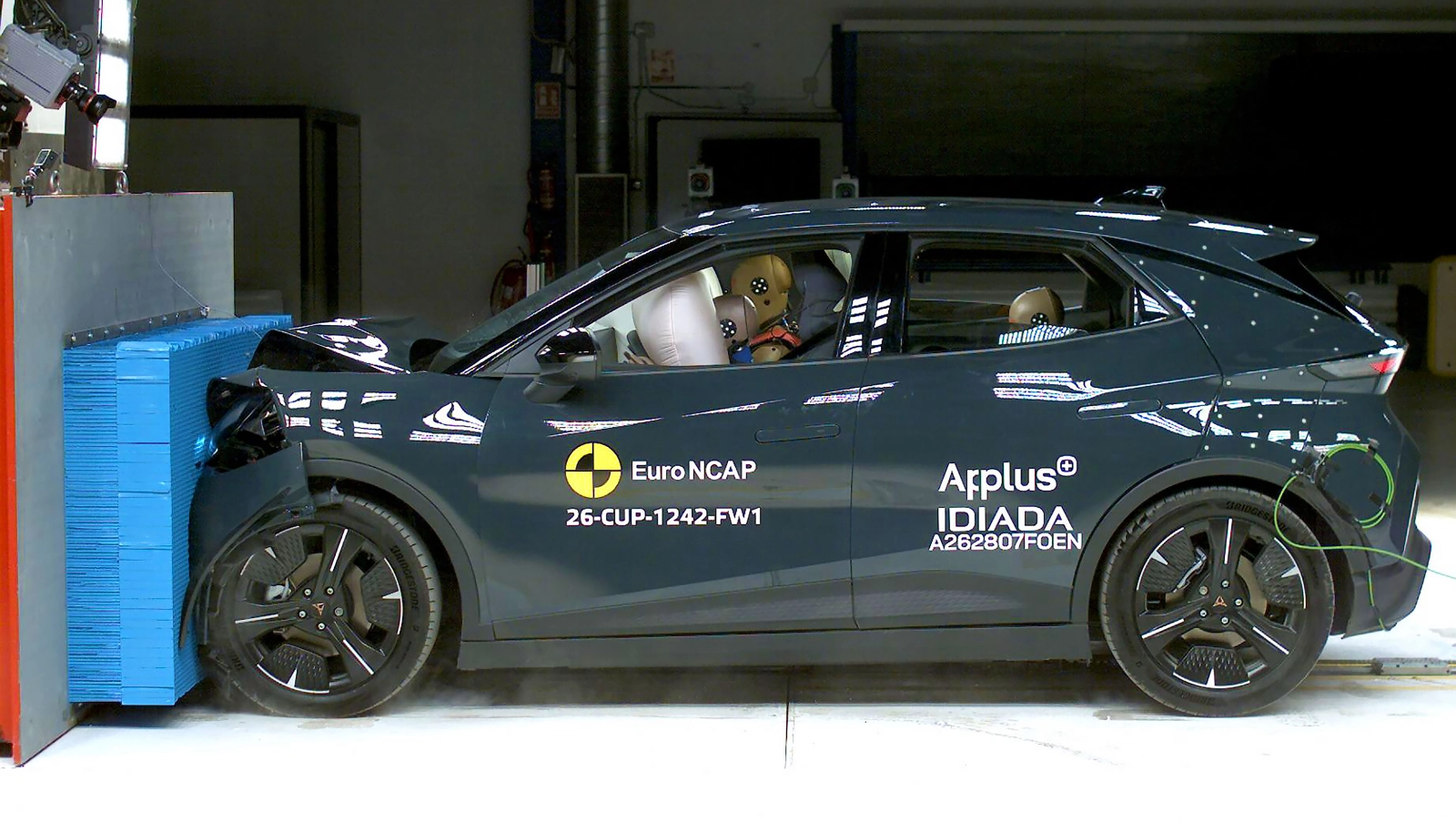
Car safety tests - four new models evaluated under new evaluation protocol
Four fully electric vehicles launched on the European market were subjected to the new series of safety tests: the Spanish Cupra Raval and three models from China – the AION UT, Geely E2 and Leapmotor B05. The Asian models achieved the maximum 5-star rating in standard equipment, while the Spanish hatchback was rated 4 stars in the standard version, reaching 5 stars only by adding the optional safety package.
New road safety assessment criteria
The testing methodology is structured around four major pillars designed to reflect the risks of modern traffic and the performance of assistance technologies:
- Safe Driving: Analyzes driver attention monitoring, control legibility, and speed limit recognition accuracy.
- Crash Avoidance: Evaluates active autonomous emergency braking systems, lane keeping assistance, vulnerable road user protection, and accidental acceleration prevention.
- Crash Protection: Measures the strength of the vehicle structure and the protection of passengers of various sizes and ages in frontal, side or rear impacts.
- Post-Crash Safety: Evaluates accessibility for emergency interventions, automatic eCall, door unlocking and power cut in electric vehicles.
CUPRA Raval – The difference between standard equipment and optional package
The Cupra Raval achieved 4 stars in its standard equipment version. With the introduction of the optional Safety Pack, the rating increases to 5 stars.
Scores broken down by the four criteria:
- Safe driving: 58% in standard equipment / 72% with optional package.
- Accident avoidance: 66% in standard equipment / 77% with optional package.
- Accident protection: 91%.
- Post-accident criterion: 95%.
The Spanish model has a solid structure for impact protection, but was devalued for the absence of a standard Child Presence Detection system.
Asian Models – AION UT, Geely E2 and Leapmotor B05 Evaluation
The Chinese models achieved a 5-star rating in standard equipment.
1. AION UT
The electric hatchback achieved the following scores:
- Safe driving: 66%.
- Accident avoidance: 74%.
- Accident protection: 91%.
- Post-accident criterion: 88%.
Recorded aspects: predominant use of the central screen to the detriment of physical buttons, an accuracy of 68% for the speed limit recognition system and the lack of alert for the presence of children in the back seat.
2. Geely E2
The model was rated 5 stars, recording the following results:
- Safe driving: 79%.
- Accident avoidance: 72%.
- Accident protection: 86%.
- Post-accident criterion: 95%.
Issues recorded: the automatic emergency braking system showed inconsistent operation in certain scenarios; points were lost in the protection of the driver's legs in an off-center frontal impact and in the belt fastening for a 10-year-old child dummy.
3. Leapmotor B05
The compact model achieved the maximum 5-star rating:
- Safe driving: 66%.
- Accident avoidance: 77%.
- Accident protection: 92%.
- Post-accident criterion: 89%.
Recorded aspects: lack of an adaptive restraint system for occupants of different heights, absence of detection of dangerous positions of the front seats and lack of physical buttons for essential functions.
Conclusions on modern car safety
Recent assessments shed light on current industry trends:
- Equipment strategy: Chinese manufacturers include most active safety systems directly as standard equipment, while some European manufacturers keep them on the optional list.
- Ergonomic standards: There is a penalty for models that completely abandon physical buttons in favor of touch screens, as well as those that omit prevention functions such as detection of children left in the vehicle.