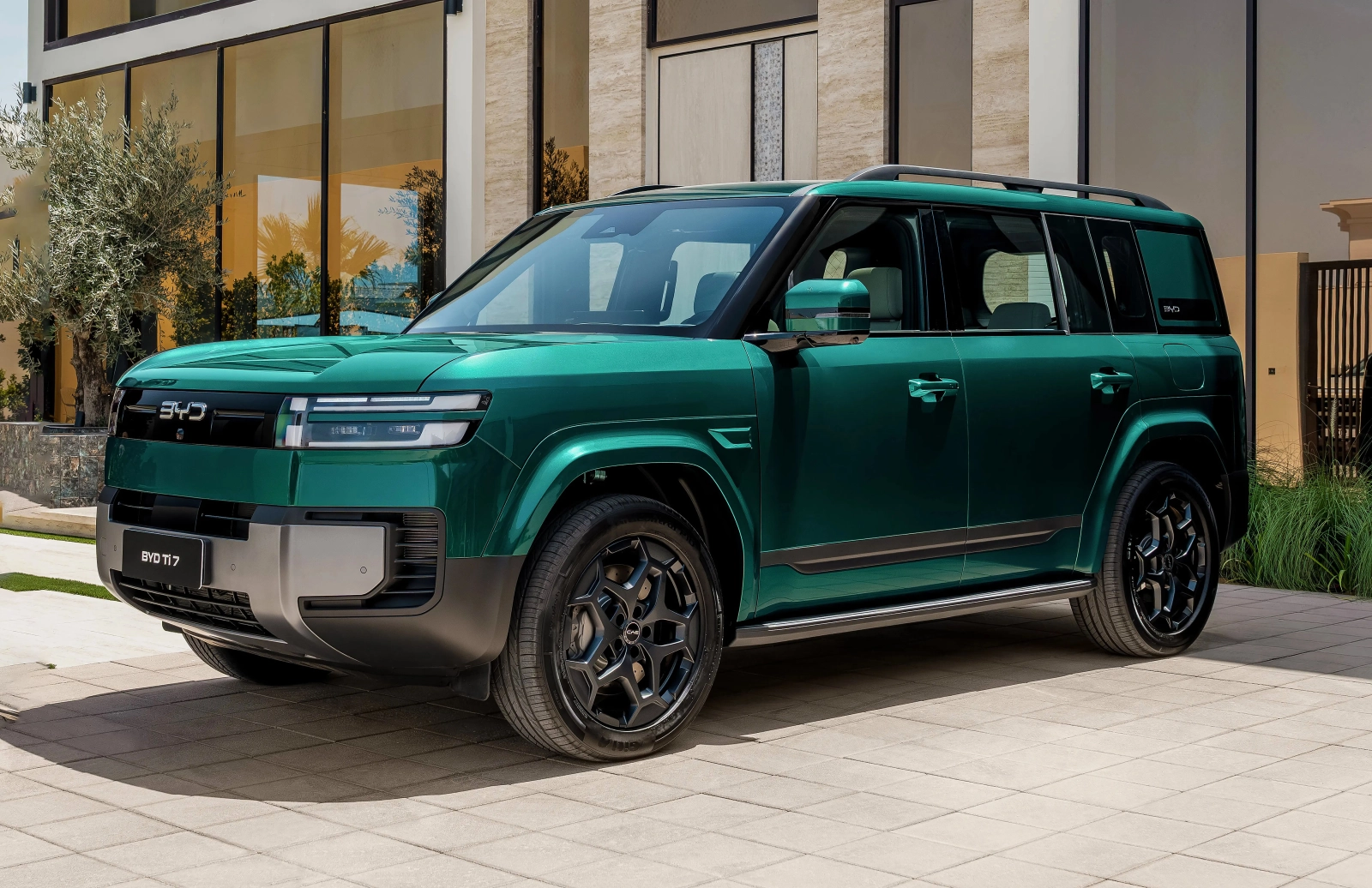
BYD Ti7 and Land Rover Defender, details about the legal scandal between JLR and the Chinese manufacturer
The global automotive landscape is being rocked by a new major legal scandal between two giants of the international market. The rivalry between traditional manufacturers and the rapid expansion of Asian brands has entered the phase of open legal confrontations, after the famous British concern JLR decided to take Chinese giant BYD to court, accusing it of serious infringement of intellectual property rights by launching the Ti7 SUV.
An old practice renewed: The BYD Ti7 model and its striking similarities to the Land Rover Defender
The Chinese auto industry has faced recurring accusations of stylistic mimicry and the taking over of design elements from established European, American or Japanese brands for many years. Although the Chinese market has evolved considerably towards its own innovation, BYD's latest project brings these controversies back to the forefront.
The Chinese manufacturer has publicly presented the new BYD Ti7, an SUV equipped with a plug-in hybrid powertrain that immediately attracted the attention of experts and the public with its exterior shapes. The model features a silhouette, proportions and body elements that are strikingly similar to the Land Rover Defender, the flagship model of the British range. This extremely pronounced visual similarity was the final straw, prompting the management of the JLR Group to move from behind-the-scenes concerns to drastic legal measures.
Reverse engineering suspicions and the lightning raids in the Netherlands
The conflict quickly went beyond a simple aesthetic dispute and escalated into a complex investigation into unfair industrial practices and the theft of technological secrets.
- Reverse engineering hypothesis: According to the details in the file, JLR Group representatives had serious suspicions that Chinese rivals had physically disassembled a Land Rover Defender to perform reverse engineering operations, aiming to copy advanced technological solutions and integrate them on the new BYD Ti7 SUV.
- Dutch raids: The legal escalation culminated in August when BYD’s European offices in the Netherlands were raided by surprise bailiffs. In the raids, authorities seized a wide range of digital documents and technical files deemed relevant to the charges.
Behind-the-scenes battles, obstruction charges and the stakes of the Hague trial
The legal battle is now being fought over the evidence gathered and legal procedures, with both sides raising strong objections in court.
- Positions of the parties: Legal representatives of the JLR Group claim that the seizure of digital documents was an imperative measure to prevent the risk of BYD destroying or concealing evidence. On the other hand, the Chinese manufacturer is vehemently retaliating, accusing the British side of abuse and stating that the executors seized far too large a volume of data, exceeding the legal framework of the search. Moreover, JLR lawyers have brought formal accusations against BYD of deliberately obstructing the investigation process.
- The next crucial deadline: The entire dispute will move to the courts in the Netherlands, at the Hague Tribunal. On November 11, magistrates are expected to issue a preliminary ruling, a decision that will determine whether BYD will be formally held liable for alleged intellectual property violations and to what extent the evidence collected remains valid in the case.
Until an official decision is made, both JLR Group and BYD representatives have refused to make any further statements on this sensitive subject, leaving the European judiciary to decide the future of one of the most heated controversies in the current automotive industry.