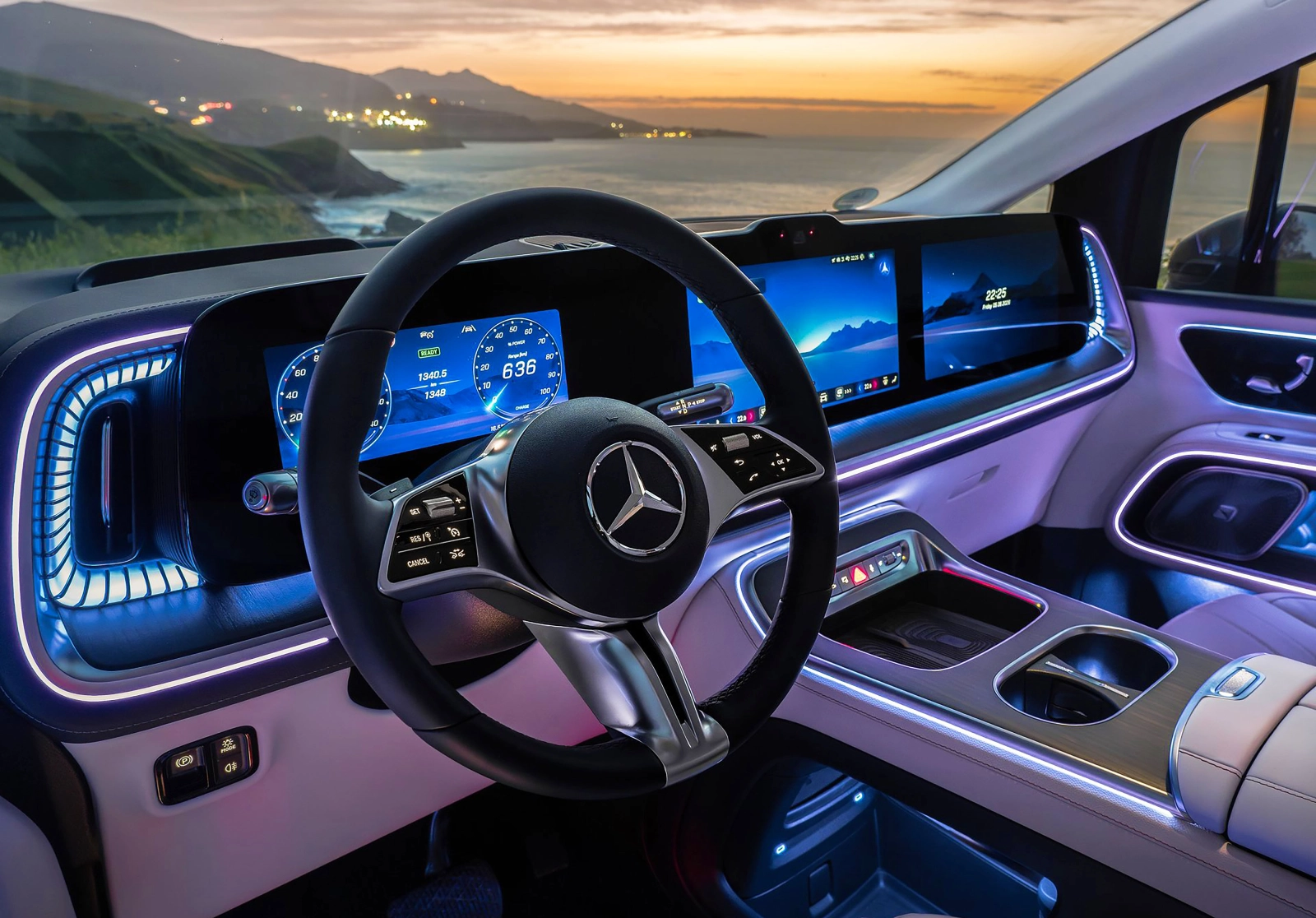
Mercedes-Benz brings back physical buttons in the cabin, but keeps giant screens
“We like big screens, but we want to have physical buttons for specific functionalities.” — Mathias Geisen, Mercedes-Benz Sales and Marketing Director
Five years ago, Mercedes-Benz stunned the automotive industry by launching the impressive massive Hyperscreen (MBUX system). It transformed the dashboard of German models into a purely digital console, almost completely eliminating traditional mechanical buttons.
Today, however, customer reactions have led to a clear change in strategy: physical buttons are returning to the passenger compartment.
What happened? Customer dissatisfaction is changing the future of car interiors
The Stuttgart-based automaker openly admits that the physical removal of controls has gone too far. While the large screens remain a visual highlight and offer huge flexibility through customization, drivers are tired of searching through submenus just to adjust the temperature or audio volume.
Mathias Geisen, the brand's sales and marketing director, confirms that the feedback from the research clinics was as direct as possible:
"When we do research, customers are very clear: 'We like big screens, but we want to have physical buttons for specific functionality,'" Geisen said.
Mercedes-Benz realized two years ago that a cabin dominated exclusively by large screens is not to everyone's taste. The first changes have already begun on some recent models: the haptic controls on the steering wheel, often criticized for being activated by mistake, have begun to be replaced with physical wheels and classic buttons.
Why will big screens NOT disappear?
Large displays will remain a central feature of German models. They offer extensive customization options, advanced navigation and software features that customers continue to appreciate. The future of Mercedes therefore means a balance between generous screens and mechanical buttons.
This decision is also supported by the new regulations of the safety body Euro NCAP, which penalize cars that do not offer dedicated physical controls for critical functions (wipers, breakdowns, turn signals or emergency call).
Mercedes-Benz in Romania: A continuously expanding market
On the Romanian market, the German brand enjoys remarkable success, with local customers having a strong affinity for the premium and luxury segment.
| Romanian Market Indicator | Details & Performance |
| Core Sales Drivers | SUVs (GLC, GLE) and executive sedans (E-Class, S-Class). |
| Top-End Luxury Segment | AMG, Maybach, G-Class, and S-Class models generate over a quarter of the brand's local sales. |
| Green Transition | A substantial portion of delivered vehicles are electrified (plug-in hybrids or 100% electric models). |
Romanian Mercedes-Benz customers seek prestige, superior comfort and cutting-edge technology. However, the daily use of purely tactile systems on the country's roads has revealed clear dissatisfaction.
What do Romanians think about touch buttons?
Drivers in Romania have been among the most vocal critics of eliminating physical buttons, and their arguments are eminently practical:
- Infrastructure and bumps: On roads with potholes, cobblestones, or bumps, accurately tapping a virtual key on a touchscreen becomes difficult without taking your attention off the road.
- Distraction while driving: Changing the temperature or operating navigation via touch controls requires time when your eyes are not focused on the traffic, increasing the risk of an accident.
- Aesthetic appearance (fingerprints and scratches): Glossy touch surfaces (Piano Black type) and large screens quickly collect fingerprints, dust and fine scratches, making them difficult to keep clean in everyday use.
- Lack of physical feedback: Muscle memory allows drivers to press a physical button without looking at it. In the case of tactile surfaces, the lack of a “click” feeling forces the driver to visually check whether the command has registered.
Conclusion
Mercedes-Benz's decision demonstrates that ergonomics and safety are returning to the forefront of the automotive industry. Spectacular screens will continue to visually dominate the dashboard, but the return to physical buttons for basic functions represents a victory of pragmatism over excessive digitalization.