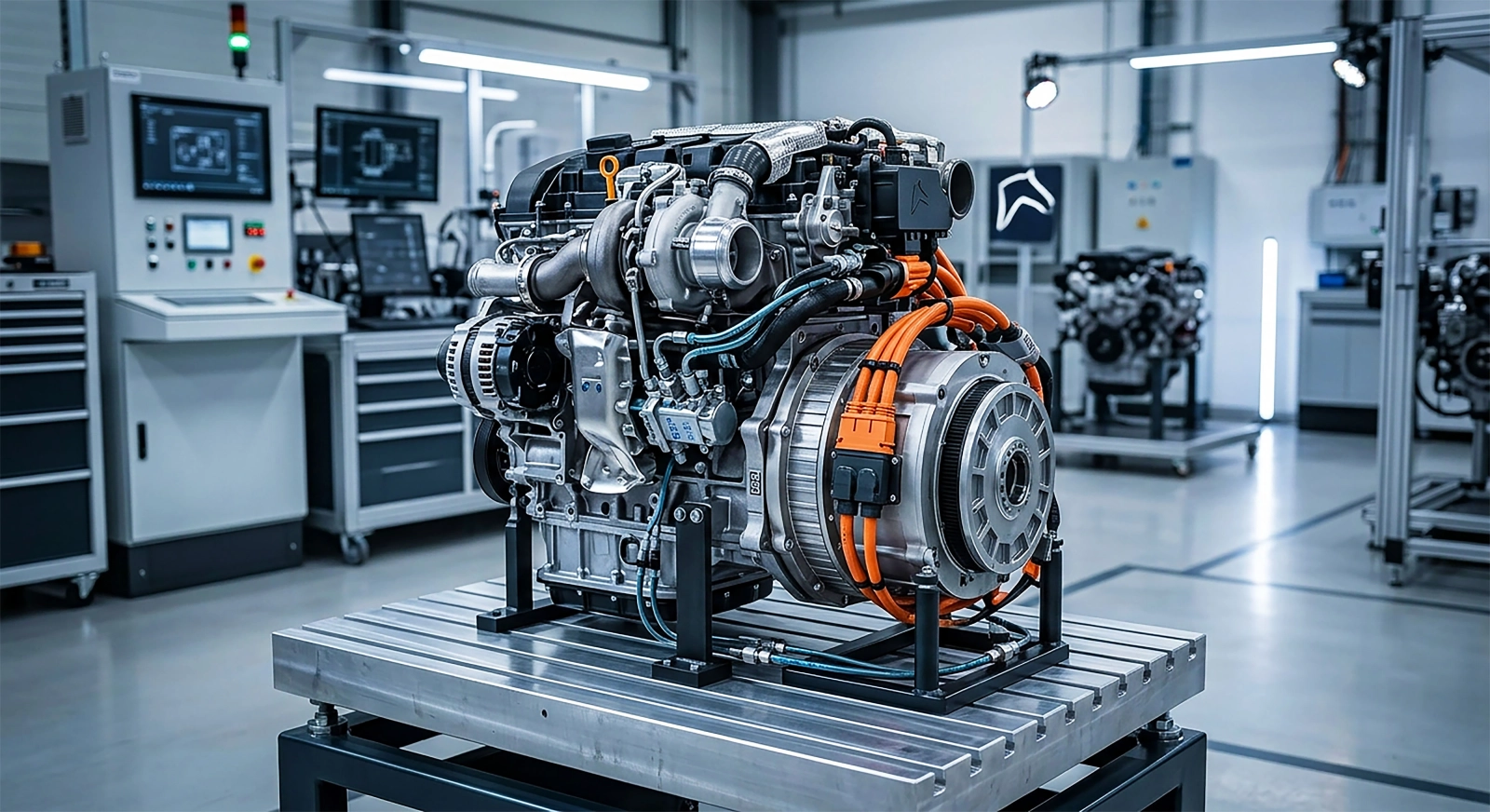
How the new Horse D20 engine-generator can change the future of Dacia models
The Horse Powertrain powertrain division — the company created by the Renault Group in partnership with Geely and Aramco — has officially presented a technological innovation aimed at redefining the concept of an extended-range electric vehicle (REEV). The new powertrain, named D20, is not intended for traditional internal combustion engines, but will be integrated into future electric models. Its role is strictly as an energy generator, charging the vehicle's battery directly while driving, without having any direct mechanical connection to the wheels.
Compact technical innovation: 143 hp fueled by methanol
The new technological assembly weighs only 170 kilograms and integrates a 2.0-liter turbocharged 4-cylinder engine, a special electric motor and the module for powering the electronic elements in an extremely compact architecture.
Developing a power of 143 horsepower (105 kW), the assembly is designed to operate on methanol, a choice that allows it to easily comply with the future strict Euro 7 pollution standards.
The technical and energy performance of this unit impresses with its efficiency:
- 96.4% electrical efficiency: The integrated generator uses axial flux technology (design without flux return housing), being significantly more compact and powerful than conventional radial flux electric motors.
- Optimized combustion: The 240 mJ high-energy ignition system allows for ultra-smooth and efficient combustion of methanol in the cylinders.
- Record energy efficiency: The fuel-to-energy conversion ratio reaches a threshold of 47% (tests indicating a consumption of about 2.1 kWh of methanol for every 1 kWh of electricity generated).
- Resistance to extreme cold: The chemical properties of methanol and the advanced ignition system guarantee trouble-free starting at extreme temperatures down to -35°C, eliminating one of the great vulnerabilities of electric cars in winter.
The efficiency of this generator is easy to quantify in practice: to fully recharge a 40 kWh battery on the go, the system consumes exactly 19.6 liters of methanol.
What does Horse D20 technology mean for Dacia?
For Dacia, the core brand of the Renault Group focused on unbeatable quality-price ratio, the launch of the D20 engine offers major strategic opportunities. Given that a significant part of the Horse division's production and engineering capabilities are located in Romania (in Mioveni and Bucharest), the Arges-based manufacturer is ideally positioned to benefit from this technology.
1. Affordable electrification without “range anxiety”
Dacia's philosophy is based on maintaining a low weight and an affordable purchase price. High-capacity batteries (80–100 kWh) are extremely expensive and heavy. By adopting an EREV architecture based on the Horse D20 engine, a future Dacia compact class or SUV model (such as Duster or Bigster) could use a much smaller and cheaper battery, around 30–40 kWh, sufficient for daily 100% electric city commuting. For long journeys, the methanol generator automatically intervenes, ensuring hundreds of kilometers of additional autonomy without prolonged stops at charging stations.
2. An ecological alternative perfectly aligned with the brand strategy
Dacia has already demonstrated its mastery of pragmatic solutions to reduce emissions through the widespread use of ECO-G (LPG) engines. The switch to alternative fuels such as methanol (sustainably obtained as e-methanol or bio-methanol) is a natural step towards low-carbon mobility. A Dacia model powered by methanol offers low emissions without being exclusively dependent on a plug-in network, still unevenly developed in Eastern Europe.
3. Consistent winter performance
The decrease in autonomy in cold weather is one of the major drawbacks complained about by electric vehicle owners. Since the D20 engine can start guaranteed down to -35°C and generates residual heat that can be redirected for cabin air conditioning and battery preheating, Dacia models equipped with this system will maintain their efficiency and comfort regardless of the season.
4. Local industrial synergy
The Horse ecosystem in Romania offers a direct competitive advantage: the integration of these solutions on the Renault Group's modular platforms (such as the CMF-B) will benefit from reduced logistics and production costs, keeping the final price of the car within the affordable limits specific to the brand.
The combination of the efficiency of the axial flow electric motor and the energy density of methanol offers the Dacia brand a realistic option for the energy transition — a practical, efficient electric solution adapted to the real needs of drivers.