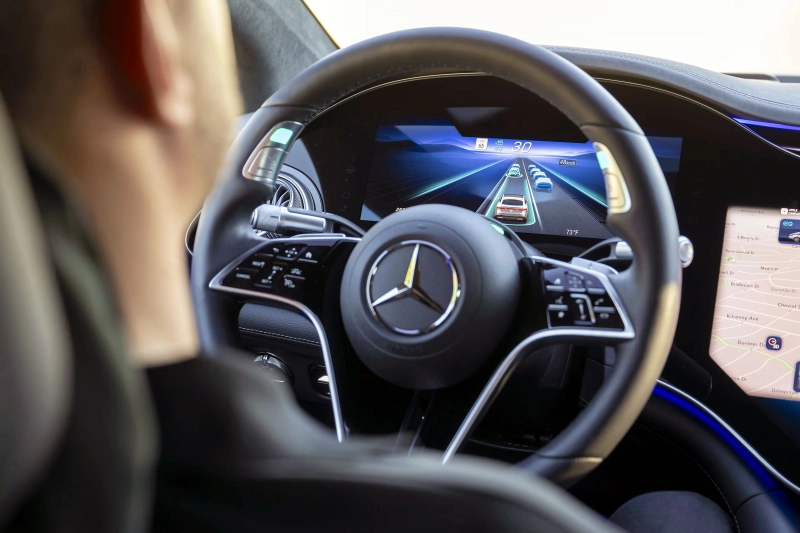
Goodbye, "hands-free"? Why BMW and Mercedes-Benz are pushing back on Level 3 autonomous driving systems
The dream of a luxury limousine driving you to the office while you check your emails seems to have hit a brick wall. In a move that took the industry by surprise, BMW and Mercedes-Benz have decided to remove Level 3 autonomous driving systems from their flagships, the 7 Series and S-Class. While the future was supposed to be about relaxing behind the wheel, the reality of 2026 shows us that technology and bureaucracy don't always make a good home.
A strategic retreat from the luxury "front"
Until recently, the battle for supremacy in the premium segment was fought over giant screens and systems that promised to turn the driver into a passenger. But with the new range updates (facelift) scheduled for this spring, the landscape is changing radically:
- BMW 7 Series: The Bavarian manufacturer has confirmed that the Personal Pilot L3 system will disappear from the list of features.
- Mercedes-Benz S-Class: The rivals from Stuttgart made an identical decision, giving up the famous Drive Pilot, the system that was the first in the world to be internationally approved for this stage of autonomy.
Why is the future "broken"? The producers' trilemma
The decision is not one of aesthetic nature, but a purely pragmatic one. The two brands have encountered a toxic mix of factors that have made Level 3 a financial black hole for the time being.
1. Legislative Chaos (European Nightmare)
Although the systems are perfectly legal in Germany and some US states (such as California and Nevada), the rest of the world — and especially the rest of Europe — has lagged behind. A 7 Series driver could legally "read the newspaper" on a motorway near Munich, but would have to be 100% attentive again as soon as they crossed the border into Austria or France. For manufacturers, it is impossible to justify the huge implementation costs for a feature that is "cut off" by law every few hundred kilometres.
2. "SF" costs, "Aprozar" request
The technology behind Level 3 isn't cheap. We're talking about high-precision LiDAR sensors, redundant radars, and massive data processing systems. These add thousands of euros to the final price of the car. In the current economic climate, customers — even those of limousines over €120,000 — seem unwilling to pay a fortune for a system they can only use in limited conditions (good weather, highway, traffic below 60-95 km/h).
3. Legal responsibility
At Level 3, if the car is in control and causes an accident, liability shifts, in certain scenarios, from the driver to the manufacturer. It's a legal risk that BMW and Mercedes-Benz seem unwilling to take so early in the technology's development.
What does Level 3 actually mean? (And what are we missing)
To understand the gravity of the decision, we need to look at the SAE (Society of Automotive Engineers) classification:
| Level | Description | Driver's Role |
| Level 2+ | Advanced Assistance (Lane Keep, Adaptive Cruise) | Must remain fully attentive at all times; hands on the wheel and eyes on the road. |
| Level 3 | Conditional Automation | May take eyes off the road; the car controls steering and braking in specific conditions. |
| Level 4/5 | High/Full Automation | The driver can sleep or engage in other activities; the vehicle may not even have a steering wheel. |
"Level 3 has always been the 'gray area' of autonomy. It's the point where the car says 'you can handle it if things go wrong,' and this split-second transfer of control remains the biggest technical challenge of the decade."
Conclusion: A step back for a leap forward?
The removal of these systems doesn’t mean that autonomous cars are dead. Instead, manufacturers now seem to be focusing on perfecting Level 2+ (highly capable assistance systems that keep the driver in charge). BMW and Mercedes-Benz have realized that until global legislation is harmonized, the “ultimate luxury” is not not driving, but having a car that helps you drive safer, without costing a fortune.
It remains to be seen whether Tesla or Chinese manufacturers will take advantage of this free space or whether all market players will accept that, for the time being, humans remain the best "processor" behind the wheel.